Built On 150 Years Of Master Fabrication.

The technical guides and spec sheets you need to lead with confidence.

OUR KNOWLEDGE. YOUR ADVANTAGE.

Resources Built for Engineers, Contractors & Facility Managers

For over 150 years we’ve solved problems in the field — not just in the office. Browse technical resources, installation guides, specification sheets, case studies and industry insights developed from real-world

ETP Environmental

Please contact us for current availability.

Account for lead times of a few weeks to fabricate a curtain in the factory. Most curtains are customs made and may not be on the shelf.

The anchorage ropes must be accounted for. The best anchorage for a turbidity curtain is a 6:1 slope, minimum. In 8 feet of water, you will require 48 feet of anchor lines on one or both sides of the curtain.

The demand on the curtain may require you to have multiples runs of curtains depending on the amount of silt in the water.

ETP Racemarks

Local conditions will determine the best anchoring method, such as buoying to “weather vane” or running the anchor line straight to the bottom from the center of the buoy. It is recommended to use an anchor line weight 4-6 feet below the buoy to keep the line from fouling competitors. Counterweights are not required for cubes or tetrahedrons, though some customers choose to use them. If you are using a ball mark or “tomato”, it features a false bottom pocket where steel shot can be poured if extra weight is needed.
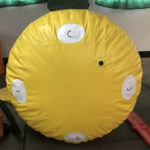
Use a 1” diameter hose fitting to inflate the buoy from a shop vac or air unit on land, or use a portable air compressor if on the water. Fill the buoy until the walls expand to about 95%—no more. Over-inflation reduces product performance, may cause premature failure, and will void any warranty. Once inflated, immediately secure the pressure relief cap so no extra air escapes. See inflation video Instructions.

Cleaning the product on a regular basis prevents stains. If dirt is left and not removed, it can partially migrate into the material, which may make future cleaning impossible.

First, place the product flat on a clean, smooth surface and wear proper footwear to avoid damaging the fabric. Using fresh water and a mild soap (nonionic cleaning agents are preferred), follow these steps:

  • Rinse away surface dirt with clean water.
  • Apply the cleaning agent by spraying it or wiping it on with a soft, non-abrasive item like a sponge or cloth.
  • Leave the cleaner on for a maximum of 5 minutes (or according to the manufacturer’s instructions), then wipe it off.
  • Use soft-haired brushes for any strongly soiled areas.
  • Rinse off all dirt and cleaner thoroughly with cold or warm water.
  • Completely dry the surface after cleaning.

To prevent damage to the PVC coated polyester fabric, you must strictly avoid the following:

  • High pressure cleaners
  • Hard brushes
  • Intense scrubbing
  • Sponges that scratch the surface
  • Abrasive powders, or liquids that scratch the surface
  • Home made cleaning agents

The PVC coated polyester fabric must always be clean and completely dry before it is put into storage. Make sure the storage area is clean and dry, and that all items are in place for proper storage.

The manufacturer of the PVC material and the final product deny any warranty and/or liability for damage that occurs during the cleaning process. Liability for the cleaning agents is restricted to the manufacturer who issued recommendations for those agents. (Note: This information reflects ETP’s knowledge as of September 2021 and is not legally binding.) If your race mark does get damaged, ETP can repair it; simply contact them with a description of the problem to get a repair estimate.